Monday, 15 June 2015

The Tilt Table / Inversion Table


The Tilt Table, or the inversion table as it is also known, is a large piece of equipment and can be quite space consuming. However, when you're in pain, I'm sure you'll sacrifice that space!
As with any large piece of gym kit, though, they can become obstacles to walk around and ignore.  Or worse, become an expensive clothes horse! So I strongly suggest you try before you buy. See if a physio can advise you of one you could rent or maybe try and buy one second hand...
Not much to write here as I’ve gone on long enough on my Vlog! I have split the vlog so if you don’t need a guided tour of the machine, skip straight to “The Tilt Table Part 2” where you can see my sexy upside down face, where I look spookily similar to ‘The Joker’ in “The Dark Night”!! 

What do you think?


The Tilt Table Part 1


The Tilt Table Part 2


Some of the main Pros

  • It feels as though the gravity takes the pressure off any squished discs almost immediately.
  • You can graduate the tilt so that you build up to being completely upside down. (I don’t quite go to the full 180 tip; I have noticed that people with tight hip flexors result in arching their lumbar region too much when upside down. Check out some of the pictures on Google images to see what I mean. That looks just as bad to compress your facet joints that way instead).
  • The machine has height adjustment on it so that your ballast can still tip you.
  • The curved handle bars rotate with you. They act as both support and an aid to assist in the tipping back action, and of course, upon returning to upright!
 Some of the main Cons
  • The ankle holders on this particular model are hard plastic and can actually decrease your time spent on the table because it soon becomes painful. Mainly because my ankles/base of calves don’t quite fit within the c-curves which means they sit on top. Therefore, I spend my weight upon the top of my feet, having to act like hooks. So the tops of the feet hurt (as well as the knees) after a short while.
  • The bolts were so cheap, my partner very kindly replaced with decent steel ones; this is not the time to have dodgy machinery when you’re headfirst towards the ground!

Monday, 8 June 2015

It's the Spinal Countdown!


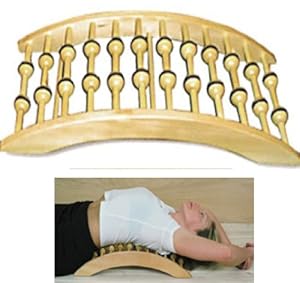
A Spinal Rack Back Stretcher, which has an 'abacus' look about it, is a great piece of kit to own.


Welcome to the “Deluxe Magnetic Back stretcher Shiatsu Spinal Rack Back Stretcher”. That’s quite a mouthful, isn’t it?

I have found this most useful for muscles that have chosen to work collectively as a 'house-brick' rather than as small moving parts, like a clock. Its rollers help you massage the area and hopefully act as a form of trigger pointing to some taught muscles.


Take a look at my vlog here for a visual on moving parts.


In my video, I reserved from speaking my thoughts regarding the magnetic strips, but I shall explain here:

In holistic therapies, it is thought that by using magnets, we can realign our body’s energy, thus resulting in homeostasis, or balance.  This product has been built with quality. However, the magnetic strips on each massage ball, are the plastic strips you might find on a cheap fridge magnet. You know the ones you might get in a cracker and when you put it on the fridge, there’s so little ‘magnetism’ in the strip that the thing slides to the bottom of the door?  It really is a gimmick, I’m afraid, but it is my only complaint on an otherwise great contraption.

Have you ever seen an animal, usually a dog who rolls around on his back and clearly looks to be enjoying the natural wriggle of quenching that itch and releasing any stress? Well, that is what I was craving to release my back, but a flat floor just wasn’t able to penetrate all the nooks and crannies, sat deep under subcutaneous fat, and into the muscles; just like a deep tissue massage. I feel like these roller balls penetrate right down to the nitty gritty. Just what you need when you’re in pain and you’ve come home late and just need immediate relief. (Steady!)

FYI: The quote within the sales pitch reads as thus:

Product Description

“…[the] frame supports, stretches and massages the lower back and spine, helping reduce pressure on each vertebra to gently realign them to a more natural, stress-free position. The rolling balls provide gentle but deep Shiatsu-style kneading, helping to increase blood flow, relieve muscle tension and bring soothing relaxation to both your back and neck. In only 15 minutes, your backache should have melted away. Crafted in quality hardwood. Guaranteed for five years…”


It also states that it is “Used and recommended by Physiotherapists”. And I completely agree to this recommendation.

Remember: it can be a little intense, so lower yourself into position gently and built your time up on it slowly! The rods do have a little ‘give’ in them, but still, it's important not to just lie on it for a long time, better to roll on it to get blood flow and massage the back muscles.


Monday, 2 February 2015

Yea But…No Butt!


Long periods of sitting down have a lot to answer for; they have left us weak…

Along with ‘slack’ abs leaving all the effort for the spine and back muscles, (particularly the QLs), the Glutes have joined the lazy club and so even more pressure is placed on our poor backs. Worse still, sitting has probably tightened our Hip Flexors and, unfortunately, the Iliopsoas Muscles attach to the lumbar segments of the spine.

When you have tight iliopsoas muscles, one of two things can happen. 
1. You look like you’re in a chair, even when you’re standing (your upper body tilts forward at the hips) and your shoulders have probably rounded. 
2. You have a deep arch in your lower back, known as Lordosis. A classic example of this is when a lady has given birth; the weight - having been on her front for so long – will have pulled at the lumbar region and therefore her hip flexors will have naturally shortened because of this.   

Well, man or woman, baby or no baby, if you’re carrying the equivalent of an extra being on your front, the chances are your lumbar region is under tension and your hip flexors have probably shortened due to the fact you ‘sit down and eat’ rather than ‘go out and do…’ I know I’m guilty as charged!

As I mentioned in my post from 22/Dec/14 (Twist and (try not to) Shout!), it isn’t all about stretching the hip flexors as that is only half of the story. The best way to stretch those muscles and ensure they return to correct length is to keep training their antagonists. In this instance the Glutes. The Bridge is a great visual to explain this example.

The Bridge: As the butt squeezes and pushes the hips up; the flexors are forced to stretch. And this is just ONE of many great exercises. Have a look on most search engines for so many variations on the Bridge, never mind all of the other great exercises out there for the butt.


NB: If you do decide to incorporate the Bridge Pose into your rehab routine, be careful not to follow the Yoga Rules. They advise that if you are squeezing your butt cheeks, then you've raised too high. They claim that their focus is on the lower abs (actually your iliopsoas muscles working eccentrically). This is exactly what we DON'T want. We want the butt to work and the iliopsoas muscles forced into a stretch. They may also mention squeezing your thighs tightly together - apparently to engage your pelvic floor. Again, this is another way to ensure your muscles misfire and you continue with incorrect form...
 
And on that Bum Note, let's move on to Squats!


Squats are mentioned in just about every fitness program in the world. However, I must warn you; if you are squatting but tilting heavily forward at the hip, chances are it is your hip flexors pulling in and your upper body will be acting as ballast. This is a classic example of weak Glutes. A great way to avoid this - certainly in the beginning, is to do squats against a wall, using a Swiss Ball. Only go as low as 90 degrees at the hip and knee joints. Squat down slower than you return to standing as it is the ‘eccentric’ (aka Negative) training which will get you fittest, quickest.


 Have a great workout!


Thursday, 29 January 2015

Go Compare: Heat Pads for Chronic Pain


Where it is essential you seek ICE in the first instance (the acute and sub acute stage needs to stem the flow of blood, whereas heat exacerbates the situation), with chronic pain, particularly herniated / impinged disc pain, the warmth of a (protected) hot water bottle on the back, is actually quite alleviating.

But it’s not always practical to walk around with a hot water bottle, is it? So companies have started developing heat patches you can stick to your skin so that you can carry on with your day.

I went ahead and tested 2 current leading patches; Thermacare Heatwraps (£5.99 for a 2 pack) and Voltarol Thermal Patch (£2.89 for a 2 pack). There are other labels on the market which I have yet to try.
 
ThermaCare Heatwraps
The pack I purchased was for the lower back and hip area. However, they have a range to ensure they mould to appropriate parts of the body, shoulders, knees etc).

The whole shape has been well thought through with individual little pockets of the heating element (iron) as well as the actual material which sticks to your skin, and is very flexible. Therefore the whole wrap envelops your contours and moves with you. You also feel the heat begin as soon as you place this against your skin. It states you can have up to 16 hours wearing it, but this thing kept emitting heat for a further 24 hours sat in my waste paper basket after use!  I was very impressed and therefore, although if you were to use them daily, it could be seen as costly. However, it was a great aid when I needed to be out and about.

Voltarol Thermal Patches
These were far less impressive.
From peeling it and having it stuck against my back, within 2 minutes the pack was already un-sticking itself (peeling at the edges) and was yet to warm up. I’d also given it a fair old shake up (like a ‘sweet n low’ as I tried to shake the iron powder into the corners of the packs so that the correct part of my body would actually benefit from this. From a brief visit to the shops, the pad had already completely unstuck itself and fell down on the floor and it never did really warm up. I was just ‘aware’ of a vague chemical reaction having taken place.  I would have been better Pritt-sticking 2 sugar packets against my back for all the good it did!
Not flexible, unable to adhere to your movements and contours, barely warm and useless shape, covering minimum area. Even though this item is cheaper than the ThermaCare wraps, it didn’t deliver on any level: I will certainly NOT be purchasing this item again. A complete waste of time and money.

Conclusion: Buy ThermaCare Heat Wraps if you need therapeutic heat whilst on the move.

Monday, 26 January 2015

Test Driven: The Backnobber II


I must start with an apology; my infantile rants about the name of this item must not detract from what a great piece of kit this truly is. So, innuendo aside, let me talk to you about the “Backnobber II”.

A simple ‘S’ shaped cousin of the ‘back scratcher’ makes all the difference when you are desperately seeking alleviation from tight/knotted muscles. Of course, a sports massage is the most constructive way to sort your grumpy muscles, but trigger pointing can really help and, after the initial purchase cost, there is no further charge for you to sort yourself out in any emergencies. It’s a way to make you independent but also, like a First Aid kit, at any time day or night, you can grab this tool and press in to any misbehaving muscles in your back, neck or shoulders.

And there’s no need to know about pressure or trigger points; your body will be sending enough signals for you to want to just ram the bulb straight in there and wiggle. In this scenario: “don’t think; feel!” (the only disclaimer I have there is, don’t press directly onto bone, or it will hurt more than muscle!)

The ‘S’ has a simple release button in the centre should you wish to halve its size and pack away in a compact case for example. 


I find this item a perfect piece of kit to add to my ‘Fix Myself Toolbag'.

Great design. It has helped me out on multiple occasions.


Monday, 12 January 2015

Back Injury: Muscle Strain or Muscle Spasm


So you’ve injured your back? It feels tight, very painful and makes you wince when you attempt to flex forward, left or right?

In the immediate situation, if you are unable to see a professional right away, a great ‘first aid kit’ to have floating around your home would be the following items:

-          Immediate answer: ice pack
-          An elastic waist band (See attached video)
-          Some Voltarol gel
-          Pain killers
-          I suggest you stay away from heat creams and packs until you know exactly what you are dealing with.

When I first couldn’t move, the muscles had gone into spasm in my back to protect the discs. It was only a few days later when, instead of easing, the pain got worse and nerves were practically vibrating into my abs and belly button. Also, an ice pack wasn’t doing anything useful; it was heat my back craved. It was then I realised this was a herniated disc at minimum and I had to really fight with my doctor for an MRI. I ended up paying out of my own money to prove I was right.

If you find yourself battling with doctors, demand a referral to a physiotherapist straight away. If you have medical insurance, demand a referral for an MRI so everyone knows what they’re dealing with. I’m sorry, but Doctors are there to minimise cost to their surgery. Mine was a great accountant; she really cared – about the bottom line in her surgery…

Drugs:

If it is just a muscle spasm, or even strain, congratulations; you will get better relatively quickly and it’s a mere incline on the graph of ‘Get Well Soon’. Your doctor may recommend Naproxen to help with the inflammation. Perhaps they may also suggest other drugs. But I would ALWAYS converse with a physio as they actually care about fixing you, not patching you up and getting you out of their surgery as quickly as possible.

Best of luck on your speedy recovery. Get the right assistance from day one and you should be fixed in no time!

Monday, 22 December 2014

Twist and (try not to) Shout!


Do you ever feel like you’re auditioning for the crappest break-dance routine ever, due to your robotic, mechanical moves? Do you avoid rotating the torso for fear of a blood curdling scream of agony?!

For 18 months my muscles have had to honour my discs and stay relatively rigid - sacrificing their flexibility in the process. This has, in turn, caused a compound effect and delayed recovery. 

This week, during a yoga stretch - known as a revolved side angle twist (from a kneeling position) - I yelped with pain, not from a disc issue, but a muscular response. I'd barely rotated, just 20 degrees if that, when it flatly advised it would not be twisting any further!

Torso flexibility is highly important and I now highly lack in this area!! I want to be more like The Destroyer from Thor and less like the Tin Man from Wizard of Oz!


So? Stretch! you might say! Sure, but it’s the type of ‘stretching’ I choose which will alleviate further issues. The best form of stretching one set of muscles is to work the opposing muscles. The ones who've been enjoying the ride for way too long; the muscles who have not been contributing will have atrophied/weakened and now need to (quite literally) pull their weight and return the favour for a while.

Most training tips these days will advise that the best way to train our abs is on a fitness ball, or to do static/isometric exercises such as ‘the plank’ etc. Well, not in this instance. We’re in rehab, so we can’t start there (or return to that point straight away if this sounds like the training you were doing before your back ‘advised’ you stop).

So yes, I guess I am referring to Isolation exercises. That should rock the functional training world!  Functional and balancing exercise routines come much later down the line after we’re fit and strong enough to take that on. When your abs, glutes etc are lazy, your back muscles have to pick up the slack (and they would only continue to take the heat, if you choose to train using the advanced ‘functional’ workouts).

So, let’s work our opposing muscles:
This form of stretching is known as passive stretching and it's the best kind. Stretching a muscle alone will not resolve the tightness. If you simply stretch a muscle, it will ping straight back again as soon as you start doing something as it still has a role to perform until you sort out the opposing weakness. Whereas if you train the agonists, the antagonists have to ‘relax’ at the same time and balance is restored.

Please Note:
If you have a weakened back because you have lived in a gym working your ‘mirror muscles’, that’s another ball game entirely and the opposite of the above blog will be true for you.  And so, this blog is for the sake of those people like me, who have done next to zero in the way of training for a very long time.